Infographics

Real estate infographics: the lifecycle on one record

Three pictures that say what the product pages spell out. One property record from development to management, the point where landlord spreadsheets stop keeping up, and the loop that returns portal leads to the unit they came from.

01 - Property lifecycle

The lifecycle of one property record
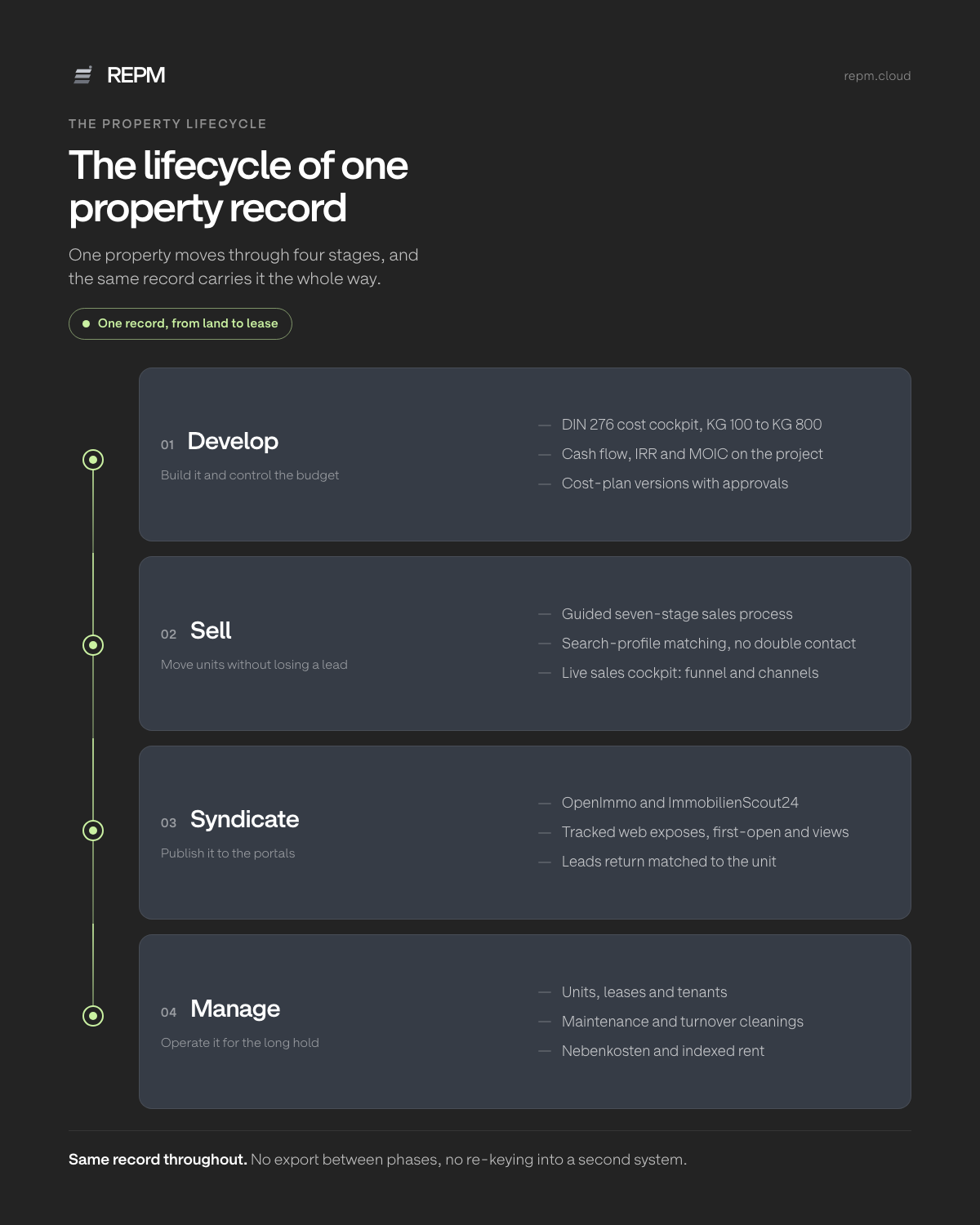
Vertical flow from Develop to Sell to Syndicate to Manage, showing the same property record carrying DIN 276 cost control, a guided sales process, OpenImmo and ImmobilienScout24 syndication, and leases and maintenance.

A property does not start life as a listing and it does not end as one. It is developed, sold, syndicated and then managed, and in most companies each of those stages lives in a different tool. REPM keeps the same record the whole way: the DIN 276 cost cockpit you build against becomes the unit you let, with no export and no re-keying in between. See how the stages fit together on the lifecycle platform, or go straight to Develop and Manage.
02 - Landlord spreadsheets

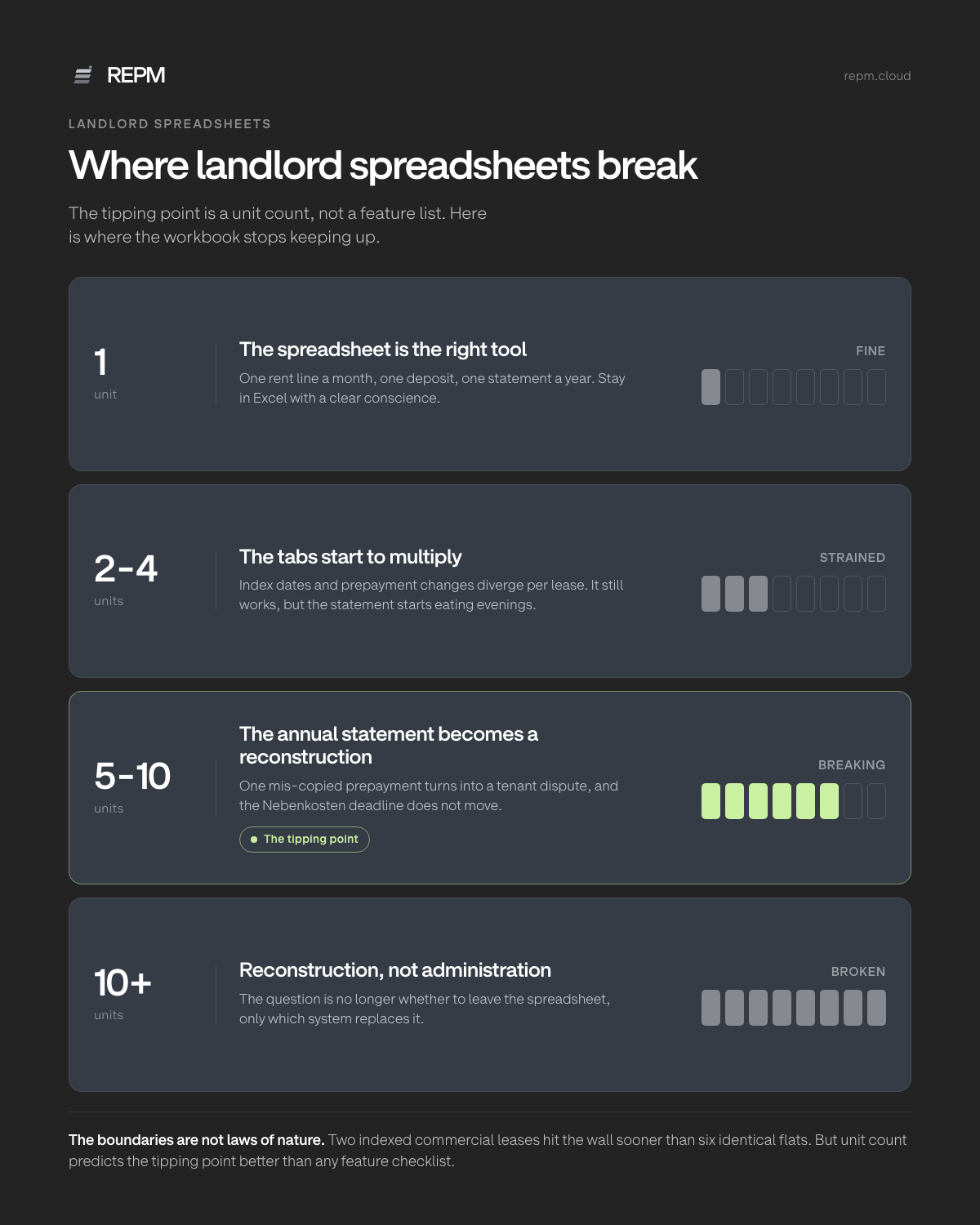
Where landlord spreadsheets break

Four tiers by unit count: one unit is fine in Excel, two to four units multiply the tabs, five to ten units make the annual statement a reconstruction and mark the tipping point, more than ten is reconstruction not administration.

The spreadsheet-versus-software argument is usually fought on features. The honest version is a workload that grows with unit count. One tenancy belongs in Excel. Somewhere between five and ten units the annual Nebenkosten statement turns into a yearly reconstruction, and one mis-copied prepayment becomes a tenant dispute. That is the tipping point this graphic marks. The long read is in REPM vs spreadsheets; the workload it replaces is property management, and the free tier that covers small portfolios is on the pricing page.

03 - Listing syndication

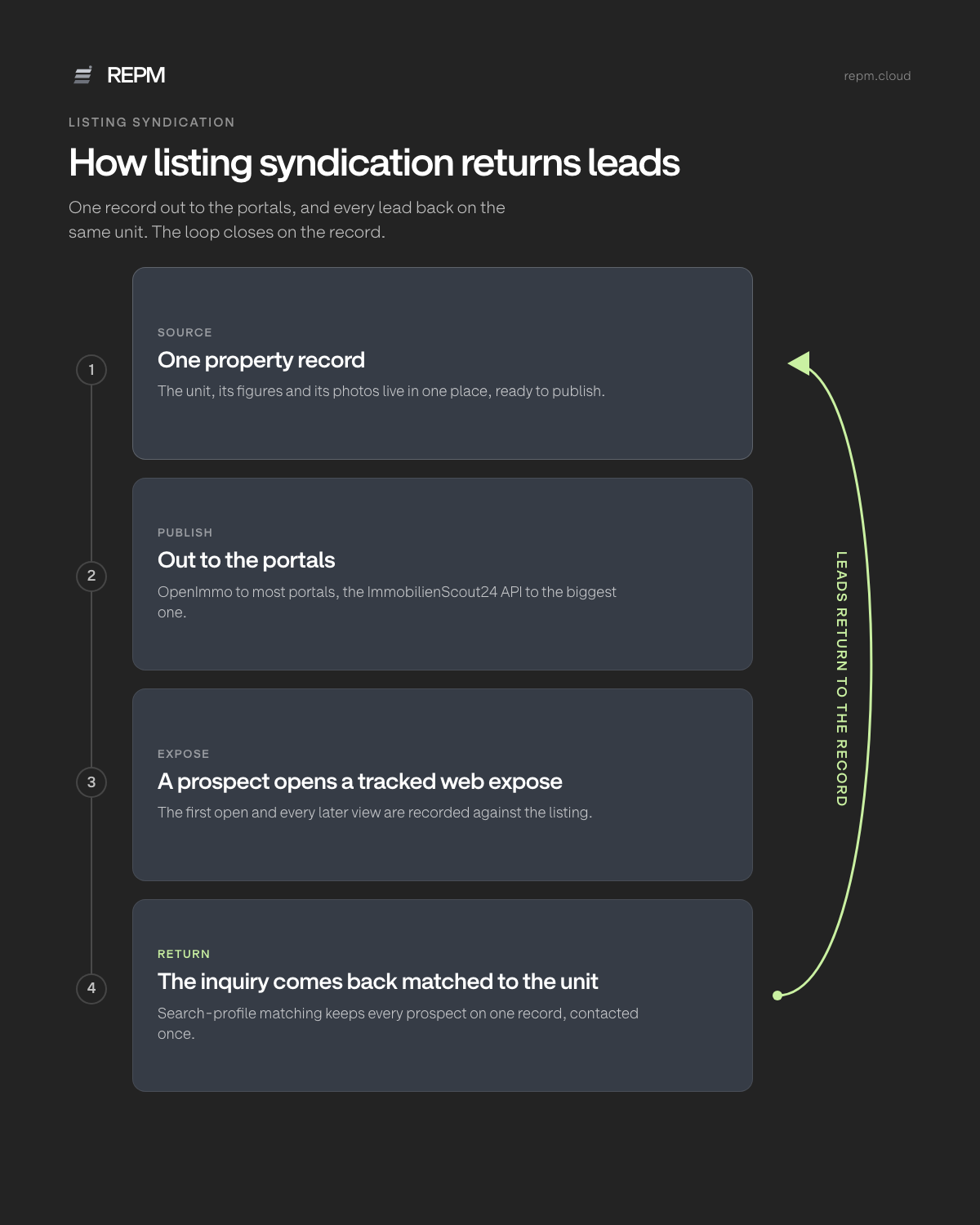
How listing syndication returns leads

A loop: one property record publishes to OpenImmo and ImmobilienScout24, a prospect opens a tracked web expose, and the inquiry returns matched to the unit, with search-profile matching keeping every prospect on one record.

Publishing a listing is only half of syndication. The half you pay the portal for is the inquiry coming back. REPM sends one record out to OpenImmo and the ImmobilienScout24 API, tracks who opens the web expose, and returns every inquiry matched to the unit it came from, so a lead lands next to the figures and the lease history rather than in a separate inbox. Search-profile matching keeps the same prospect from being contacted twice. See the connectors on the integrations page.

Frequently asked questions

What is DIN 276 and why is it in the first infographic?

DIN 276 is the German standard order for construction costs, cost groups KG 100 to KG 800. In REPM those groups sit on the project record as a cost cockpit with live plan-versus-actual variances, so the cost history survives into the standing asset. The DIN 276 guide covers it in full.

At how many units should a landlord leave the spreadsheet?

There is no fixed number, but for most landlords the tipping point sits between five and ten units, where the annual service-charge statement becomes a multi-week reconstruction. Two indexed commercial leases reach it sooner. REPM vs spreadsheets works through it in detail.

Where do portal leads go after syndication?

Back to the property record the listing came from. An inquiry from ImmobilienScout24 or an OpenImmo portal returns matched to the unit, next to its figures and lease history, and search-profile matching keeps the same prospect from being contacted twice.

See it on one property record

Start the free 30-day Lite trial and put a real property through the lifecycle, or ask for an assisted Enterprise trial set up on your own data.

Start free